
This Trader Turned $20,000 into $70 Million by Breaking Every Wall Street Rule. Here's How.
Imagine turning a $20,000 investment into a verified fortune of over $70 million. Now, imagine doing it without ever looking at a stock chart. Trader Chris Camilillo did exactly that, achieving an average annual return of over 70% for nearly two decades. And this isn't ancient history; he recently revealed, "This is actually the second best year I've had in 18 years." The secret to his success is a paradox that defies all conventional financial wisdom: he rejects complex analysis and instead spends his nights reading TikTok comments.
Camilillo’s strategy is a radical departure from the doctrines of Wall Street. He believes the average person’s greatest advantage isn’t found in financial reports or technical indicators, but in paying attention to the world around them. This is a distillation of his most counter-intuitive yet powerful principles for finding a real edge in the market.
Takeaway 1: Throw Out Your Charts and Complicated Reports
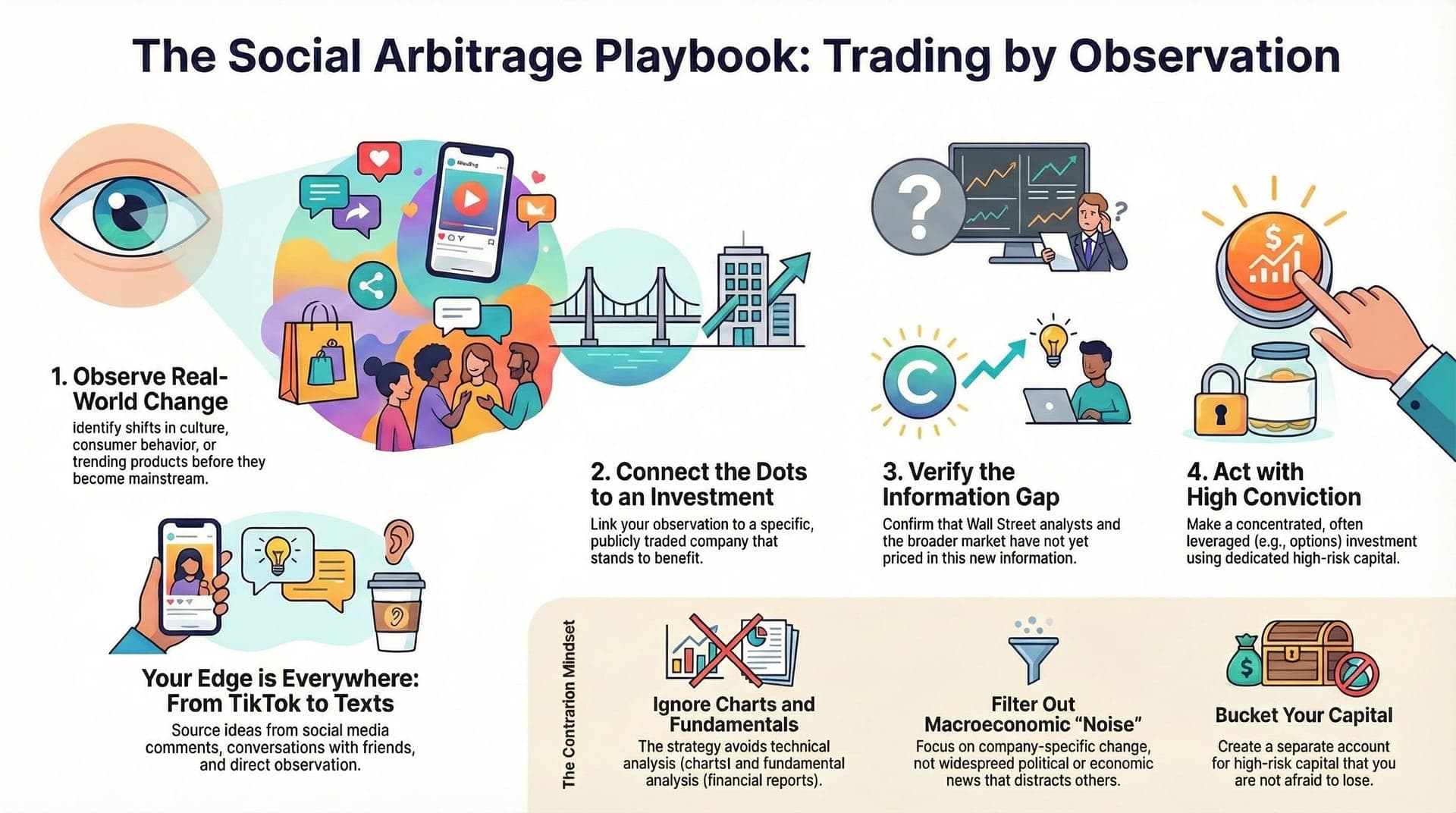
Camilillo’s first rule is to throw out the old rulebooks. He has an outright rejection of both technical analysis (charting) and fundamental analysis (evaluating company financials). He finds technical trading unappealing for "normal people" and believes that trying to beat career Wall Street analysts at their own fundamental game is a "ridiculous" proposition. Why try to out-analyze someone whose entire life is dedicated to it? As he puts it, "...being a better analyst than the guy that went to Wharton... do you really want to outedge that person... that seems ridiculous to me."
His stance is uncompromising and frees the individual investor from the pressure of mastering complex financial disciplines.
"I don't do technical trading I don't do fundamental trading Maybe that's for you I would rather shoot myself I cannot imagine that that appeals to more than 2% of normal people."
This principle is radical because it liberates the average person from the belief that they need specialized, esoteric knowledge to succeed. Instead of trying to beat the professionals at their own game, he argues you should play a different game entirely.
Takeaway 2: Your Real Edge Is Hiding in TikTok Comments
If charts and fundamentals are out, what’s in? For Camilillo, the answer is "social arbitrage," or what he also calls "observational investing." His core strategy involves spending hours every night sifting through TikTok comments to detect shifts in culture, consumer behavior, and trending products long before they show up in mainstream data.
He believes this "conversational data," while messy and interpretive, allows him to get ahead of the "clean" data sets that Wall Street relies on. By analyzing what people are talking about, you can understand their intentions before they act. For example, if you're watching fashion videos and "...you see 400 people in the comments saying 'Yeah that is the coolest skirt I've ever seen.' ... It's fairly representative that that's going to be a hit product."
"if you're analyzing speech and comments you're able to get inside of the head of humans before they act on something no matter what that is... you're essentially getting ahead of the data sets that Wall Street uses to historically get ahead of earnings"
Takeaway 3: You Have an Advantage Over the Pros
Camilillo is a firm believer that regular people—what Wall Street dismissively calls "retail investors" or "dumb money"—have a massive, inherent advantage over institutional professionals. In fact, he named his brand "Dumb Money" to poke fun at this very label.
His reasoning is simple: Wall Street is an echo chamber. Professionals are prone to groupthink and are disconnected from the realities of everyday life. As Camilillo observes, "They mostly look the same They mostly have the same come from the same background... They live the same... We don't generally live in just one of three cities." In contrast, regular people are on the front lines of societal change.
"We see things that institutional Wall Street doesn't see We see things sooner than they see them because... we're actually living the change We're part of it We see it in our neighbors our friends our family our co-workers"
Takeaway 4: Trade the Information, Not the Price
Perhaps Camilillo's most radical philosophy is his attempt to execute trades without being influenced by the stock's price. His framework is built on trading an "information asymmetry." A recent trade in Sphere Entertainment (MSGS) perfectly illustrates this.
The trade started not with a chart, but with a text from a friend raving about a sold-out Backstreet Boys concert at the Sphere in Las Vegas. This was the catalyst. Camilillo immediately dove into social media and ticket sales data. He discovered that a new AI-driven Wizard of Oz movie at the venue was also going viral on TikTok, with thousands of comments from people planning family trips to see it. He saw that presales were unlike anything the venue had seen before. This was his "information"—a needle-moving insight the market hadn't yet priced in.
He entered the trade heavily. His exit wasn't tied to a price target, but to the moment of "information parity"—when the rest of the world caught on. Sure enough, about a week and a half later, articles and investor chatter began highlighting the success of the new shows. That was his signal to sell. The result? The stock jumped 50% in a few weeks, and the information gap was closed.
"my exit window on that trade is when the rest of the market sees what I saw... The price of the stock has nothing to do with when I purchased or when I sold."
Takeaway 5: Create a Dedicated "High-Risk" Bucket
How could Camilillo make such a huge bet on Sphere? His approach to risk management isn't about diversification in the traditional sense; it's about bucketing money properly. He argues that a key separator for the wealthy is having capital specifically "earmarked for higher risk higher reward."
He advises that everyone, regardless of their net worth, should create a separate account for this purpose—money you are not afraid to lose. This psychologically frees you to make concentrated, high-conviction bets. This is the capital he uses for his social arbitrage plays, where he might invest anywhere from 5% to 30% of his total liquid portfolio in a single idea.
Crucially, this is also what enables outsized returns through leverage. For the Sphere trade, he explains, "because I trade a lot of options... it wasn't stock that I bought it was stock options." By using options, a 50% move in the stock generated a return of "three or 400%" on his capital.
Conclusion: What Change Do You See?
Chris Camilillo's success offers a different paradigm for investing. It's about cutting through the noise. While most of the financial world is consumed by macroeconomics and politics, Camilillo is looking for the real-world signals they miss. In his words, "everyone's talking about Powell... Trump... and war... and like no one's actually granularly talking about the impact that Wizard of Oz and Backstreet Boys are having on Spear."
His journey from $20,000 to over $70 million is a testament to the power of seeing what others miss in plain sight. It leaves us with a final, thought-provoking question: What trends, products, or cultural shifts are you seeing in your daily life that Wall Street is too busy to notice?
Latest
More from the site
Martin Uetz
Introduction
I’m Martin Uetz — a Swiss-born, Iceland-connected entrepreneur, CEO, investor, and explorer of the human spirit in the age of artificial intelligence. My life sits at the intersection of business, tec
Read post
Martin Uetz
Business
Insurance Companies: How They Work, Top Players, and Investment Perspectives
How Insurance Companies Operate and Make Money Insurance companies have a unique business model that relies on both underwriting (collecting premiums and paying claims) and investment income. In simpl
Read post
Martin Uetz
Politics
Why Buying Greenland Was Never a Joke
When the United States floated the idea of "buying" Greenland in 2019, the global reaction ranged from amusement to outrage. It was dismissed as the whims of a real estate tycoon treating a sovereign
Read post