
The Five Pillars for Reaching Scratch
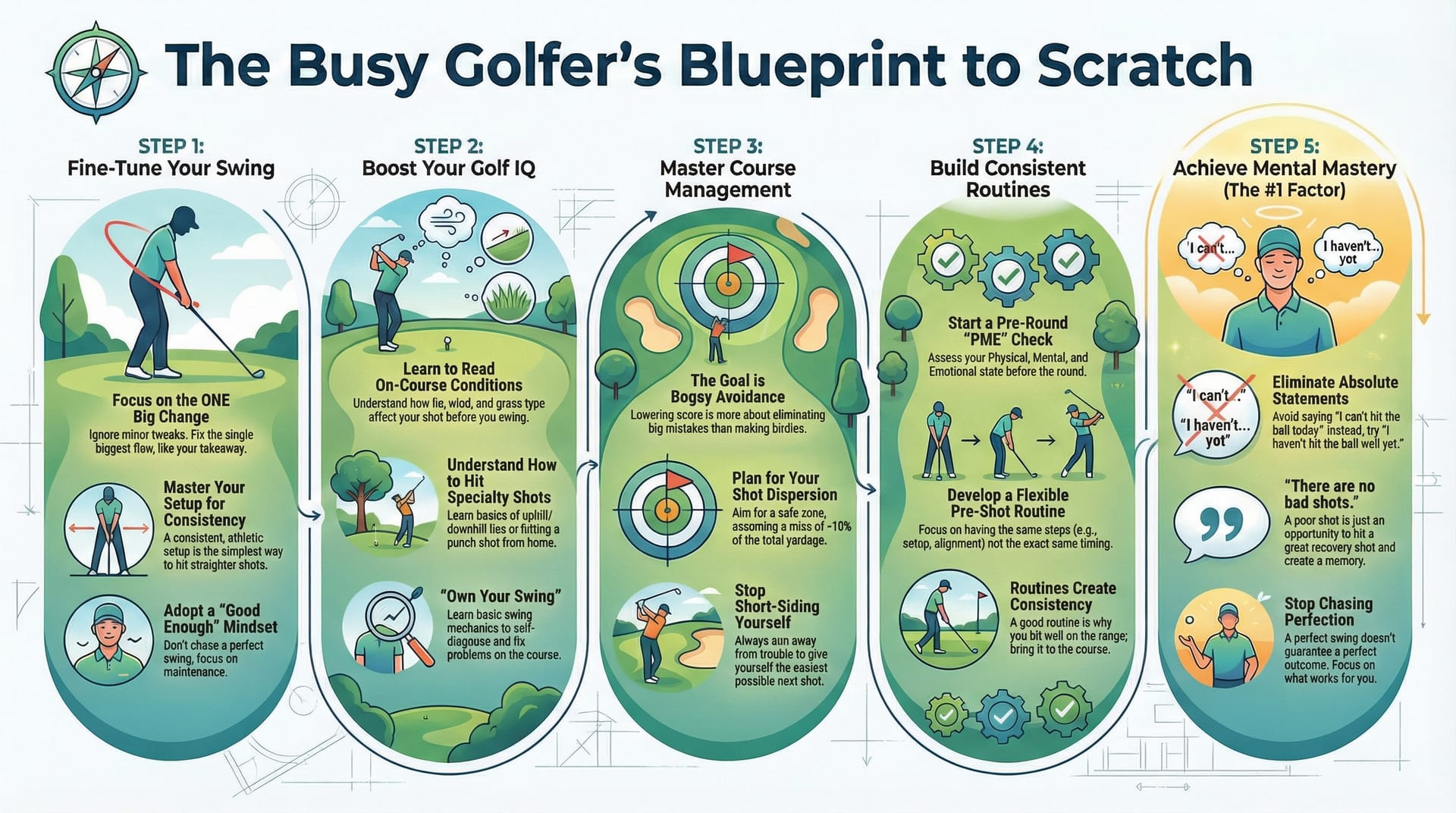
The path to a scratch handicap is built upon five foundational areas of focus. This framework is designed for individuals with limited time, prioritizing efficiency and high-impact improvements.
1. Foundational Swing Changes
While swing perfection is a myth, targeted adjustments are necessary. The focus should be on major, foundational changes rather than minor tweaks, applying an 80/20 principle to practice.
- Identify and Fix the "One Big Move": Most golfers have one primary, recurring swing flaw that causes a cascade of other problems. This is often an issue early in the swing, such as an incorrect takeaway or poor setup.
- Example: The speaker identified a narrow stance as a core issue in his own swing. Widening his stance provided a more stable and athletic base, which corrected several downstream compensations in his downswing. Another key issue was a takeaway that was too far inside, leading to an "over the top" motion.
- Master the Setup: A consistent and correct setup is the simplest way to achieve consistency. Pros dedicate significant time to their setup for every shot. Amateurs can use alignment sticks and create physical cues (e.g., tape on a stick) to ensure proper distance from the ball and alignment.
- Adopt a "Good Enough" Focus: There are diminishing returns in perfecting a swing. Once a swing change is approximately 10% better, it is often more effective to move on to another area of the game and loop back later. The goal is swing maintenance over constant, time-consuming overhauls.
- Avoid Chasing Perfection: There is no single "perfect swing." Effective swings, like those of Adam Scott and Scottie Scheffler, can look vastly different. Chasing a textbook aesthetic can be a detriment, as the game is played with multiple skills, not just the swing. An obsession with swing perfection takes valuable time away from other crucial parts of the game.
2. Developing Golf IQ
Improving one's understanding of the game's nuances is a critical component that can be developed off the course. This involves learning to assess and adapt to the countless variables encountered during a round.
- Understand Course Conditions: The ability to compensate for environmental factors is crucial. This includes:
- Lie: The lie of the ball is paramount, as it dictates how the club can interact with the ball.
- Wind: Wind dramatically affects ball flight, especially on shots with higher spin.
- Other Factors: Temperature, type of grass, and elevation all influence shot distance and outcome.
- Master Shot Adjustments: Golf is rarely played from a flat lie. It is essential to learn the fundamental adjustments required for shots from uphill, downhill, and sidehill lies (ball above or below feet).
- Learn Specialty Shots: A scratch golfer must be able to execute shots from difficult situations, such as a low punch shot from under trees or various types of bunker shots (e.g., downhill lie in a bunker).
- "Own Your Swing": Golfers should develop a deep understanding of their own swing mechanics and general golf principles. This empowers them to self-diagnose and correct issues on the course without waiting for a coach. Resources like Tiger Woods' book How I Play Golf are recommended for building this foundational knowledge. This self-sufficiency prevents the grooving of bad habits between lessons.
3. Strategic Course Management
Course management is fundamentally about playing smart shots and avoiding costly errors, with the primary goal being bogey avoidance.
- Play Smart Shots: This is a cornerstone of lowering scores.
- No Short-Siding: This is identified as one of the simplest and most effective ways to save shots. Always aim away from trouble, leaving an easier subsequent shot.
- Understand Shot Dispersion: Golf shots are more like a shotgun pattern than a laser. A practical rule of thumb is to plan for a dispersion of 10% of the total yardage (e.g., a 30-yard-wide cone for a 150-yard shot). Aiming should account for this entire cone, not just the target line.
- Hit the Simple Shot: Avoid trying to shape shots (e.g., "nuanced baby fade") when a straight shot at the target will suffice.
- Set Realistic Expectations: Understanding professional performance statistics can recalibrate expectations and reduce on-course frustration.
- Proximity: In 2025, the PGA Tour leader in proximity to the hole from inside 100 yards averaged over 13 feet.
- Putting: Pros make approximately 50% of their 8-foot putts, while amateurs are closer to 50% from 6 feet. Getting annoyed about missing a 6-foot putt is statistically unwarranted.
- Plan Beforehand: Using modern tools like the Grint app or Shot Pattern, golfers can study a course before playing. This pre-planning, which can include analyzing hole layouts and elevation changes, calms the mind and reduces the cognitive load on the course, as the brain feels it has "already done this work."
4. Pre-Round and Pre-Shot Routines
Consistency in performance is a direct result of consistency in preparation. Establishing firm routines for both the pre-round and pre-shot phases creates a stable platform for success.
- The Pre-Round Routine: A golfer is a different person each day due to variations in sleep, mood, and physical state. A pre-round routine helps assess and standardize the starting point.
- PME Assessment: Before a round, perform a quick "Physical, Mental, Emotional" (PME) check. Rate each on a simple 1-to-3 scale to understand your state. This is not to predict performance but to inform strategy (e.g., a physically tired player might choose more conservative plays).
- Consistent Warm-up: A proper physical warm-up ensures the body recruits the correct muscles for the golf swing, preventing compensations and inconsistency.
- Set Input-Based Goals: Set simple goals for the day that are within your control (e.g., "I will focus on my setup for every shot") rather than outcome-based goals ("I will shoot even par").
- Clear the Mind: Take a moment before the first tee to mentally set aside external stressors and focus solely on the round ahead.
- The Pre-Shot Routine: This is essential for transferring range skill to the course.
- Focus on Steps, Not Time: While top pros have highly timed routines (e.g., Tiger Woods at 15.6 seconds), amateurs should focus on executing the same sequence of steps rather than a rigid duration.
- Allow Flexibility: If a step in the routine feels wrong (e.g., alignment feels off), it is critical to reset and start again. The 10 seconds spent resetting is far more valuable than the time lost recovering from a poor shot.
- A Simple Routine: A suggested starting routine includes creating a mental "bubble" of focus, lining up from behind the ball, setting the clubface to an intermediate target, aligning the feet, and executing.
5. Mental Mastery
Identified as the single most important factor, mental mastery is the foundation that enables all other pillars to function effectively. The approach is defined by a series of beliefs and mental frameworks to adopt by eliminating their negative counterparts.
| Principle | Ineffective Mindset (To Avoid) | Effective Mindset (To Adopt) |
|---|---|---|
| No Absolutes | "I can't hit the ball today." "I can never read these greens." | "I have not been able to hit the ball well yet." Frame statements in a way that allows for future success. |
| No Feeling Stuck | "I'm stuck and I can't fix this." | "This is something I'm trying to figure out." Adopt a belief that every problem has a solution waiting to be discovered. |
| Nothing is "Hard" | "That's a hard shot." This mindset creates mental weight. | "That is a low-probability shot." This is a more accurate, less intimidating framing that focuses on execution. |
| No "Bad" Shots | Defining a shot that misses its target as "bad," which creates negative momentum. | A shot is only "bad" after the next one. A missed green followed by a chip-in is a birdie. View errant shots as opportunities for memorable recovery shots. |
| No "Perfect" Swing | Believing a perfect swing is necessary or that it guarantees a perfect outcome. | A "good enough" swing is sufficient. The ball only responds to impact dynamics, not the aesthetics of the backswing. |
| No Predictions | "I've hit two bad shots, so I'm going to hit another." | One shot has no bearing on the next. Start each shot from a mental "zero." If making predictions, only predict positive outcomes. |
| No Rushing | Expecting to drop multiple strokes overnight, leading to frustration. | Embrace incremental progress. "We grossly overestimate what we can accomplish in a year and grossly underestimate what we can accomplish in 10 years." One shot of improvement per month is a 12-stroke improvement in a year. |
| Cautious Optimism | "I hope I hit a good drive." This implies doubt. | Provide yourself with internal validation. Pat yourself on the back for small accomplishments. Play for yourself, not for the external validation of others. |
The Immediate Action Blueprint
To begin the journey, the following are the first, high-impact items to work on within each pillar.
| Pillar | Action Items |
|---|---|
| Swing Changes | 1. Setup: Take a video of your setup and compare it to a PGA Tour player with a similar build. This is the 80% change that yields the most momentum. 2. Takeaway: This is the most common "one big thing" that needs correction for most amateurs. |
| Golf IQ | 1. Learn Wind & Bunkers: Master how wind affects your ball flight and the basics of playing from different types of sand and bunker lies (uphill/downhill). 2. Start "Owning Your Swing": Begin the process of learning your own mechanics to enable self-correction. |
| Course Management | 1. Account for Dispersion: In the next round, apply a 5-10% dispersion rule. Aim every shot so that the entire dispersion cone is in a "safe" area. |
| Routines | 1. Implement PME: Before your next round, take 10 seconds to assess your Physical, Mental, and Emotional state on a 1-3 scale. 2. Simple Pre-Shot Routine: Focus on two things: creating a mental "bubble" of focus and perfecting your setup. |
| Mental Mastery | 1. Lay Off Absolutes: Actively catch and rephrase absolute negative statements (e.g., "I'm playing terribly") into more constructive, forward-looking ones. Use positive self-talk like "I'm an athlete" over a low-probability shot. |
Latest
More from the site
Martin Uetz
Introduction
I’m Martin Uetz — a Swiss-born, Iceland-connected entrepreneur, CEO, investor, and explorer of the human spirit in the age of artificial intelligence. My life sits at the intersection of business, tec
Read post
Martin Uetz
Business
Insurance Companies: How They Work, Top Players, and Investment Perspectives
How Insurance Companies Operate and Make Money Insurance companies have a unique business model that relies on both underwriting (collecting premiums and paying claims) and investment income. In simpl
Read post
Martin Uetz
Politics
Why Buying Greenland Was Never a Joke
When the United States floated the idea of "buying" Greenland in 2019, the global reaction ranged from amusement to outrage. It was dismissed as the whims of a real estate tycoon treating a sovereign
Read post