AI / Wanderings 2026
Repetitions
AI can extend our thinking or remove the effort that builds it. Neuroplasticity makes both directions possible, so the repetitions matter.
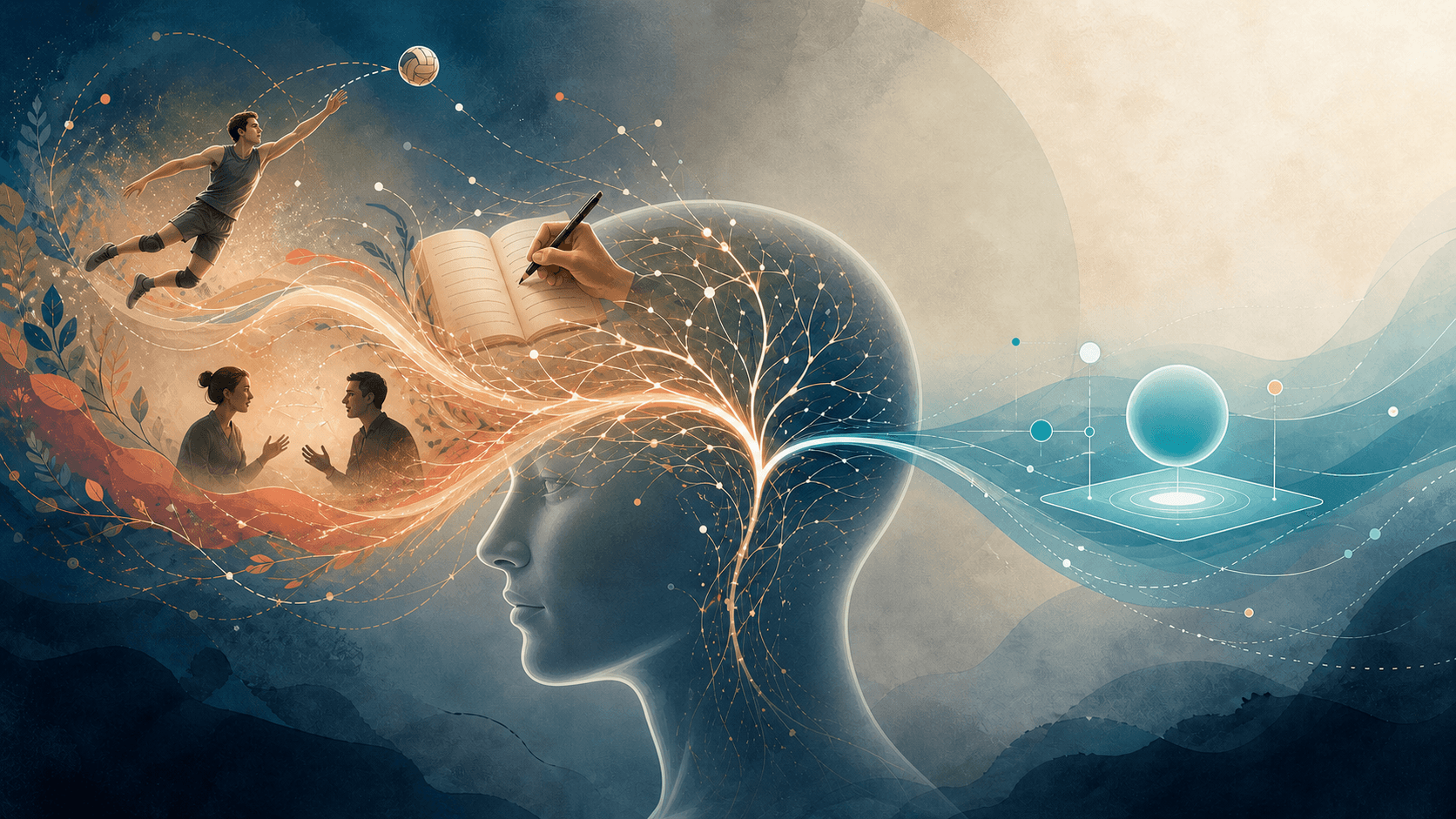
In 1998, I was doing three demanding things at the same time.
At HP, I was working in EMEA Channel Marketing and building an information system that delivered content on 22,000 products across 80 countries, in 20 languages, to 40,000 partners.
At Fachhochschule Aargau in Baden, I was studying Business Administration.
And I was playing indoor volleyball in Switzerland's Nationalliga A, while also competing in beach volleyball at Swiss national level.
The same brain moved between three settings and three kinds of pressure: systems thinking, study, memory, physical coordination, team communication and decisions made in fractions of a second.
I cannot tell you which neural connections changed during those years. I can tell you exactly what I repeatedly asked my brain to do.
AI is now changing those repetitions, which is why the distinction matters.
The brain keeps adapting
Neuroplasticity is the brain’s ability to make lasting changes in neural function, connectivity or structure in response to experience. It continues into adulthood.
A 2004 Nature experiment asked adults to learn juggling. Brain scans showed changes in grey matter after training, followed by partial reversal when participants stopped practising. Juggling is a small task compared with building a career or learning a complex sport, but the result makes the basic point visible: repeated experience leaves a biological trace.
Plasticity does not guarantee improvement. The brain and our behaviour adapt to repeated demands, including useful skills and bad habits. The effects are task-specific, and some training effects diminish when practice stops.
We do not yet have convincing long-term evidence showing what years of generative AI use will do to the structure of a healthy adult brain. The technology is young, and a recent review in Trends in Cognitive Sciences makes a careful distinction between evidence about learning a skill and much broader claims about losing basic cognitive ability.
Any claim today about what future brain scans will show is speculative.
We already know that repetition, attention, challenge, feedback, emotion and recovery shape learning. AI can change several of those conditions. That gives us enough reason to pay attention.
My brain had a different job then
During my HP, university and volleyball years, much of the mental resistance came with the task.
At HP, I was turning information on 22,000 products into a system that 40,000 partners could use.
At university, I had to retrieve what I had learned without a friendly prompt box offering a polished paragraph.
On a volleyball court, late timing has an immediate result. The ball is already on the floor.
Today, my work is different. As the founder of humAIne, it spans AI, energy, health and longevity, robotics and capital. I use AI constantly. It can help me enter an unfamiliar subject, compare arguments, challenge a plan and draft faster.
That shifts more of the work towards framing questions, setting a standard, checking evidence, connecting fields and deciding what I am willing to own. Raw recall can carry less of the load. The shift is valuable when I keep doing the judgement myself.
The temptation is real. Recognition can feel like recall. Editing a fluent answer can feel as if I formed the argument myself, while moving quickly across subjects can leave very little depth behind.
A 2025 study of 319 knowledge workers found that generative AI shifted critical-thinking work towards verification, integration and task stewardship. Higher confidence in the AI was associated with less self-reported critical-thinking effort. The researchers used a self-report survey with no brain scans, but it describes the shift well.
Back then, the mental lifting was built into many tasks. Today, I have to choose where to keep it.
The two directions are already visible
AI can reduce useful practice or create more of it.
A 2025 randomised study with nearly 1,000 secondary-school students tested generative AI in maths learning. Students with unrestricted access to GPT-4 performed better during supported practice, then worse than the control group when they had to complete an exam without AI. A tutor designed to give hints and guardrails improved practice performance while largely removing that later penalty. Unaided exam performance with the guarded tutor remained statistically comparable to the control group.
The study covered four sessions in one school and measured learning. It included no brain measures. Still, the mechanism should be familiar to any athlete. An answer can complete the immediate task. A hint can keep the learner inside the attempt.
There is encouraging evidence in the other direction too. In a randomised crossover study with Harvard physics students, a carefully designed AI tutor produced stronger immediate learning gains than an active-learning class. The system used expert-written prompts, solutions and teaching materials. It did not hand students an unstructured chatbot and wish them luck. The study covered two lessons, so it tells us little about long-term retention. It does show what becomes possible when AI is designed around learning, with answer production placed second.
Psychologists call the wider behaviour cognitive offloading. We have always done it. We write notes, set reminders, use calculators and let GPS remember the route. A 2016 review of cognitive offloading shows why this is often sensible: external tools can improve performance and free limited mental capacity.
The trade-off appears when the tool carries the operation we wanted to train.
If my goal is to send an accurate meeting invitation, I am happy for technology to remember the time. If my goal is to understand a company, outsourcing the analysis leaves me with a finished document and very little judgement of my own.
Completion and learning are separate objectives. I need to choose which one matters before I open the prompt box.
What sports psychology adds
My years in volleyball still give me a useful model for AI. A good coach improves the quality of practice while the athlete keeps doing the movement.
Feedback makes the mistake useful. I learn when I can see an error, understand it, adjust and try again. AI can shorten that loop. It can challenge an assumption, compare my explanation with evidence or point to a missing step. I still need to make the next attempt.
Difficulty must move with ability. Repeating a comfortable drill can create fluency without much progress. After six weeks, a small motor-learning study found that progressive practice improved performance on the harder version of the trained task and increased some measures of corticospinal excitability. The study did not test AI, but the coaching principle transfers well: increase difficulty as skill grows. Asking AI for the finished answer may bypass the challenge the learner needs.
Mental rehearsal can complement physical practice. Sports psychology has long used imagery to rehearse timing and movement. A review of motor-imagery research summarised brain-stimulation and imaging findings consistent with cortical reorganisation accompanying improvements in performance. Imagery adds a useful signal. The athlete still needs physical repetitions, the ball and the awkward correction when the imagined movement meets reality.
Psychological state changes the practice. Short-lived stress can sometimes strengthen memory around an event. Extreme or chronic stress can impair learning and memory. Much of the detailed mechanistic evidence comes from animal research, and human responses vary by person and situation. This neuroscience review on stress gives the more complicated picture. Believing I can improve may keep me practising after a bad session. The belief does none of the biological work by itself.
Recovery belongs to training. Learning continues after the visible effort ends. A meta-analysis of 48 studies found a small benefit of sleep, on average, for consolidating motor memories. AI can save time. Spending every saved minute on more output would be a fairly stupid bargain if it removes the sleep, movement and quiet that help learning settle.
Sports-psychology methods can influence attention, motivation, feedback, emotional meaning and persistence. Those conditions influence which repetitions happen and how well we learn from them. There is no magic mindset switch for neuroplasticity.
How I want to use AI now
I want AI to increase the quality of my repetitions. A few rules help:
Decide whether I need output or learning. Both are legitimate. Confusing them causes the problem.
Make an attempt before asking. Write the rough argument, predict the answer or identify the decision first. Give the brain something to compare with the response.
Ask for hints and questions. Let AI expose a gap, vary the difficulty or offer a counterargument. Keep the main attempt mine.
Close the tool and retrieve. Explain the idea from memory, in plain language, to another person. If I cannot do that, the answer remains borrowed. I have not learned it well enough for independent recall.
Verify and disagree. A fluent response can still be wrong. Ask for sources, open them, examine the assumptions and decide where the answer fails.
Protect human repetitions. Physical movement, quiet thought, difficult conversations, original judgement and sleep still need space. Use part of the time AI saves to do more of those things.
In 1998, I repeatedly asked my brain to move between building systems, studying and practising volleyball.
Today, AI can help me search, compare, challenge and draft faster. I also carry more responsibility for choosing which mental work remains mine.
A volleyball coach can analyse my movement, correct the angle and feed me the next ball. I still have to jump, and that is the repetition I need to protect.