AI / Wanderings 2026
Ghosts
AI can build the face and much of the machinery of a brand. The scarce part is accountability: who made the promise and who fixes the failure?
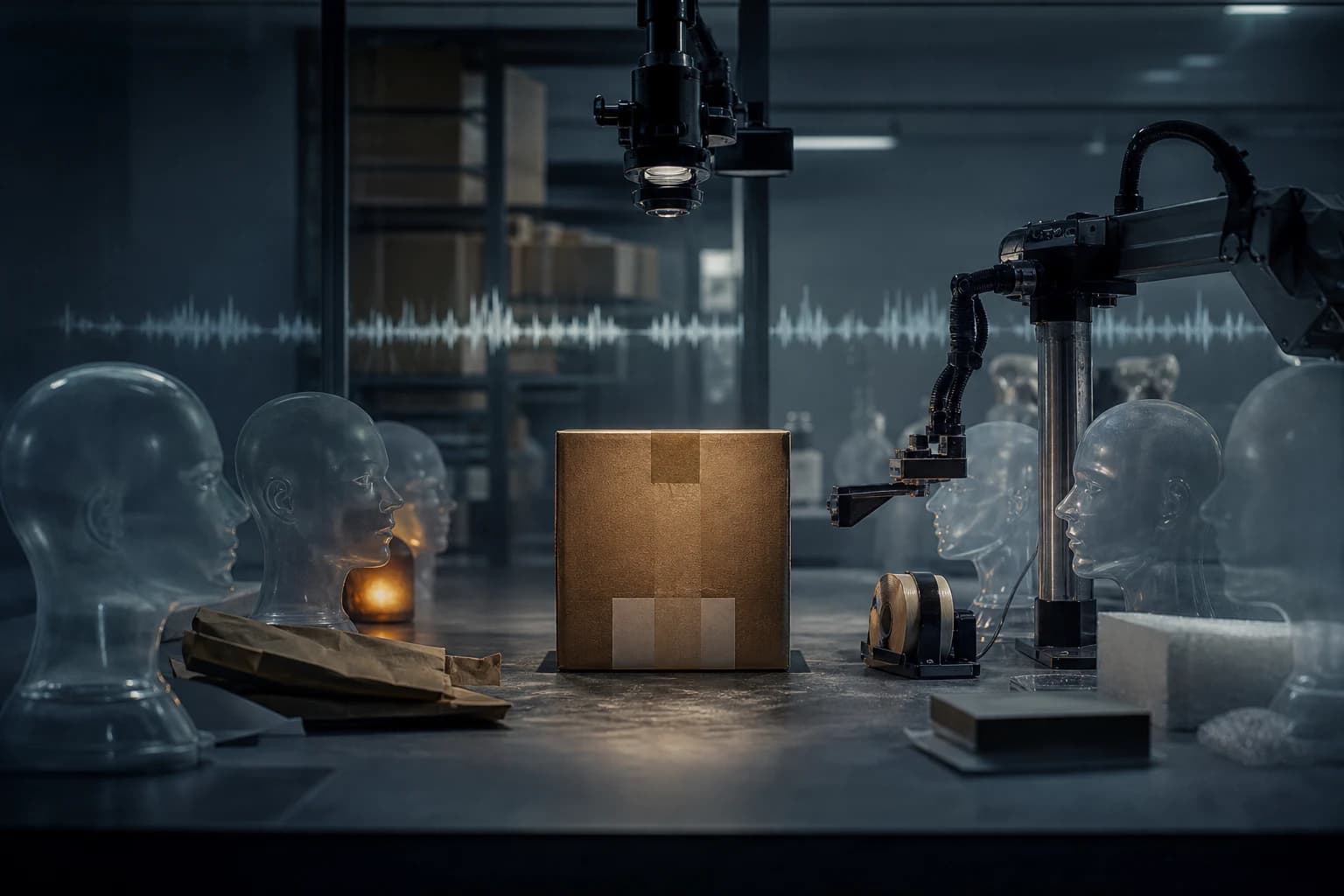
By lunchtime, one person can create a company that looks as if a full team has been at work for months: name, logo, photographic campaign, product descriptions, a customer-service voice that never needs coffee and a friendly founder avatar with perfect teeth and no childhood.
The shop and products may be real even when the story around them has no human life behind it.
I call this the ghost economy.
Switzerland already gave me a physical version. I recently wrote about virtual restaurants on delivery apps: a brand and recipe placed on top of somebody else's existing kitchen. The meal arrives. The restaurant name may exist only in the app. AI pushes the same pattern across the rest of the economy.
There is nothing automatically fraudulent about it. A small company can use AI to look professional, serve customers abroad and compete with a much larger incumbent. That is a serious gain. The problem begins when nobody can tell which parts are fictional, who is making the promise and who will take responsibility when something goes wrong.
A company with almost no visible people
The pieces are already on the market.
Shopify now puts AI into store design, product copy, images, email, customer support and back-office work. Its Sidekick assistant can analyse store data, manage orders, edit products, create content and work on longer tasks in the background. It presents changes for review before applying them. Add stock avatars, synthetic voice and AI shopping channels, and a founder can assemble a public-facing organisation with remarkably few humans.
Current products still keep people in the approval loop for many changes. Humans sign the contracts, own the bank account and carry the legal risk. The fully autonomous company remains a forecast. The cost of appearing like a sizeable company has already collapsed.
That gives small operators reach they could never afford before. It also gives weak products a very handsome disguise.
Brands have always contained fiction
The Michelin Man has never changed a tyre. Tony the Tiger has never eaten breakfast. Customers cope perfectly well with invented characters because the fiction is visible.
The line gets crossed when fiction is presented as evidence.
A synthetic spokesperson says she used a skin cream for three weeks. A generated customer review describes a hotel stay that never happened. A support agent promises a refund and the legal entity later dismisses the promise as a machine error. A founder avatar tells a moving first-person story that belongs to nobody.
These examples share one problem: the customer is asked to rely on an experience, identity or commitment that has no accountable source.
US regulators have already drawn part of this line. The Federal Trade Commission's review rule covers reviews or testimonials attributed to people who do not exist, including AI-generated fake reviews. Its guidance says virtual influencers and stock avatars are not banned as a category. The underlying testimonial still has to be real, and the use of an avatar can still be deceptive under the FTC Act.
The distinction makes sense because advertising can use a fictional character without inventing a customer experience.
Trust needs an owner
Research on virtual influencers gives no tidy verdict. One experiment found that disclosing a virtual influencer's origin reduced perceived humanness and changed how emotional posts affected credibility. Another experiment found that informing users about an endorser's artificial nature did not reduce perceptions of the influencer or the sponsored brand in that setting.
People may accept a virtual character. A claim about experience still needs evidence, and a failed purchase still needs a remedy.
Trust requires a responsible counterparty, whether the face is human, illustrated or generated. I want to know who owns the stock, who wrote the warranty, who can approve the refund and which legal entity stands behind the offer. An “AI-generated” badge answers none of those questions.
This is where brand building changes. Cheap content makes content less impressive. A convincing face becomes easy to make. Consistency, proof and service become more valuable because they cost time and bind the company to its promises.
The labels are arriving
On 2 August 2026, the EU AI Act's Article 50 transparency duties start applying to specified AI-generated content. Providers must support machine-readable marking and detection for certain synthetic outputs. Deployers must visibly disclose deepfakes and some AI-generated public-interest text.
California's AI Transparency Act becomes operative on the same day. Covered providers with more than one million monthly users must offer detection tools and include latent provenance disclosures in generated image, video and audio. Large online platforms face further provenance duties from 2027.
Platforms have moved in the same direction. YouTube requires creators to disclose realistic altered or synthetic content, and TikTok has started reading Content Credentials so that some AI-generated uploads can be labelled automatically.
The policy direction is clear: origin data is becoming part of the product.
Origin data still cannot settle whether a claim is true. The C2PA standard can make a content history tamper-evident and record which tools were used. Its own explainer says Content Credentials do not judge whether the content is factual, and provenance metadata can be incomplete or removed.
A signed lie remains a lie. We know who signed it, which is progress.
How to build a synthetic brand people can trust
I would require five things.
Name the owner. Put the legal entity, trading address and responsible contact where a customer can find them. A beautiful avatar is no substitute for a counterparty.
Disclose synthetic identity at the moment it matters. A label hidden in a privacy policy is useless when a persona is giving advice, making a claim or asking for money.
Separate character from testimony. Let a virtual host explain the product. Use real, verifiable customers for claims about customer experience.
Make agents accountable inside the company. Record what the support agent promised, set approval limits and give customers a clear route to a person who can resolve the issue. “The model said it” should never become an escape clause.
Keep the receipts. Preserve product origin, content provenance, approvals, service logs and changes to price or terms. Regulators may ask for them. Good operators should want them anyway.
Where I think this goes
The production tools are available, and the first transparency rules take effect in 2026. The market effects below are my forecast.
We will see many more disposable brands. They will test a product, buy attention and disappear as soon as returns, advertising costs or customer complaints catch up with them. AI makes this cheap enough to do repeatedly.
We will also see excellent virtual brands that are open about being virtual. Their characters may be fictional while their manufacturing, warranties, service and ownership are easy to verify. Those companies can build trust because they do not ask the customer to confuse theatre with evidence.
Marketplaces, payment providers and social platforms may become the identity layer for this economy. They already sit between the ghost and the customer. Verified principals, reserve requirements, complaint histories and provenance records would give them a stronger trust product than another small badge under a video.
Real footage from a factory, an identifiable expert and a customer willing to attach their name to an experience will carry more weight as synthetic media gets cheaper. Human-origin material will become expensive proof.
Regulation will probably move from “Was AI used?” towards harder questions: Who authorised the claim? Who benefited? Who is liable? What remedy does the customer have?
If you build one of these companies, publish the legal entity, product origin, synthetic-media policy and complaint route. Test that route yourself, then make sure a responsible person answers the complaint.