AI / Wanderings 2026
Forecast
AI weather models are gaining useful forecast lead time at a pace that once took a decade. For a cyclone, another day can save lives.
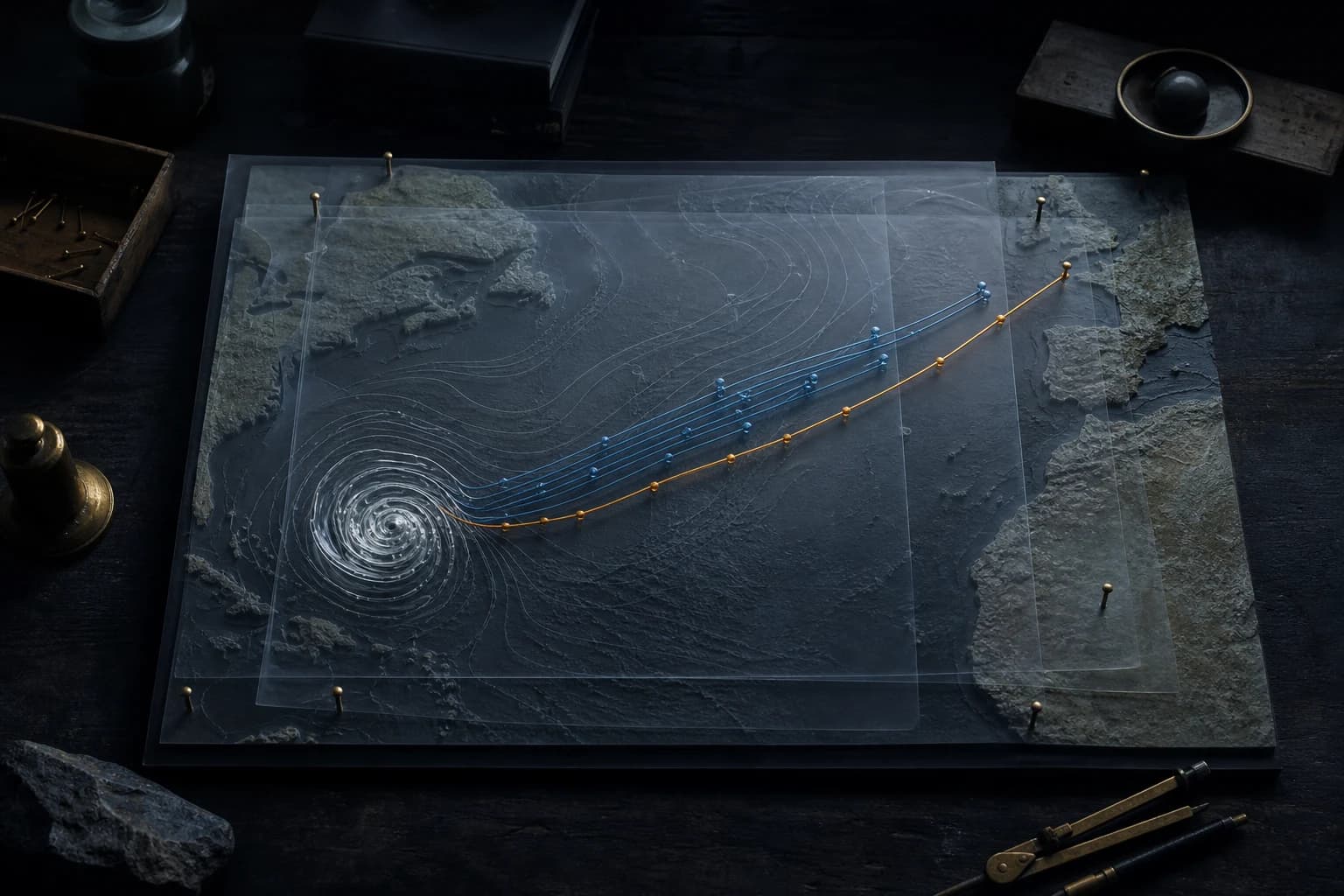
Weather forecasting improved at a remarkably steady pace for much of modern meteorology. A useful rule of thumb was one additional day of skill every decade: a seven-day forecast in 2023 was about as accurate as a five-day forecast in 2000 and a three-day forecast in 1980.
AI models have begun to compress that timetable.
Google introduced WeatherNext 2 in November 2025. In one evaluation, its ensemble-mean tropical-cyclone tracks at three days were roughly as accurate as those from its predecessor at two days.
For a hurricane, one more day matters. It gives authorities another 24 hours to evacuate a city, another 24 hours to move aircraft, ships and emergency equipment, and another 24 hours to decide whether a hospital needs to be cleared.
A research model does not issue an evacuation order. Meteorological agencies still combine models with observations and human judgement. Better guidance gives them more time and a clearer view of the risks.
In that cyclone-track benchmark, WeatherNext 2 gained about 24 hours over its predecessor. That is similar in scale to a decade under the historical rule of thumb.
Cyclone tracks are one measure. Across its main atmospheric scorecard, WeatherNext 2 beat WeatherNext Gen on 99.9% of the variable, pressure-level and forecast-time combinations tested. The average improvement in the probabilistic score was 6.5%, with some gains reaching 18%.
Meanwhile, the European Centre for Medium-Range Weather Forecasts put AIFS Single into operation in February 2025, followed by a 50-member AI ensemble in July. Its 2025 verification found medium-range errors 5–15% lower than its physics-based system for most upper-air and surface parameters. Precipitation skill improved by about 10%, equivalent to half a day to one full forecast day.
These are large gains in a field used to measuring progress across decades.
For decades, forecasters built predictions by measuring the atmosphere, describing its physics mathematically and feeding the equations into increasingly powerful supercomputers.
AI adds another route. At forecast time, it predicts how one atmospheric state will evolve without explicitly calculating every physical interaction. Its foundations remain thoroughly meteorological. The training data and starting conditions still depend on observations, data assimilation and physics-based models.
AI did not wander into the weather office and discover clouds by itself.
Once trained, though, the model is fast and cheap to run. WeatherNext 2 can generate hundreds of possible 15-day trajectories from one starting state. Each trajectory takes less than a minute on one Google TPU. Comparable physics-based forecasts can take hours on a supercomputer.
The low cost changes what forecasters can produce. Weather is uncertain. A crisp line on a map can hide that uncertainty; an ensemble shows a range of plausible futures and the probability around them.
For a hurricane approaching Miami, fifty plausible tracks reveal how much of the coast needs to prepare, where the tracks cluster and where the forecast could still go badly wrong. Planners can move resources according to risk without pretending there is one certain future.
The atmosphere still sets a limit. It is chaotic. Tiny uncertainties today grow into enormous ones tomorrow. AI cannot repeal physics, and it probably will not tell us whether it will rain in Zürich at 14:17 three months from now.
It can push forecasts closer to the limits physics allows.
Forecast skill varies by place, weather pattern and variable. Detailed local prediction is generally useful for about a week; farther out, ensembles and larger-scale probabilities become more important.
If today's five-day confidence reaches seven days, today's seven-day confidence reaches ten and fourteen-day probabilities become useful often enough to plan around, ordinary life gets more convenient.
Agriculture, aviation, shipping, energy markets, insurance and disaster preparedness get more time to make expensive decisions.
Weather is also a useful test case for AI in a mature scientific discipline with good data.
WeatherNext inherits more than four decades of reanalysis built from satellites, weather stations, aircraft, ships and balloons, combined with physics-based modelling, data assimilation and human expertise. AI extracts predictive value from that work in another way.
Biology, materials science, medicine and energy have similar raw material: decades of data, hard-won knowledge and expensive unanswered questions.
The work now is to find where the data is good enough, test the gains properly and use the time AI gives us.